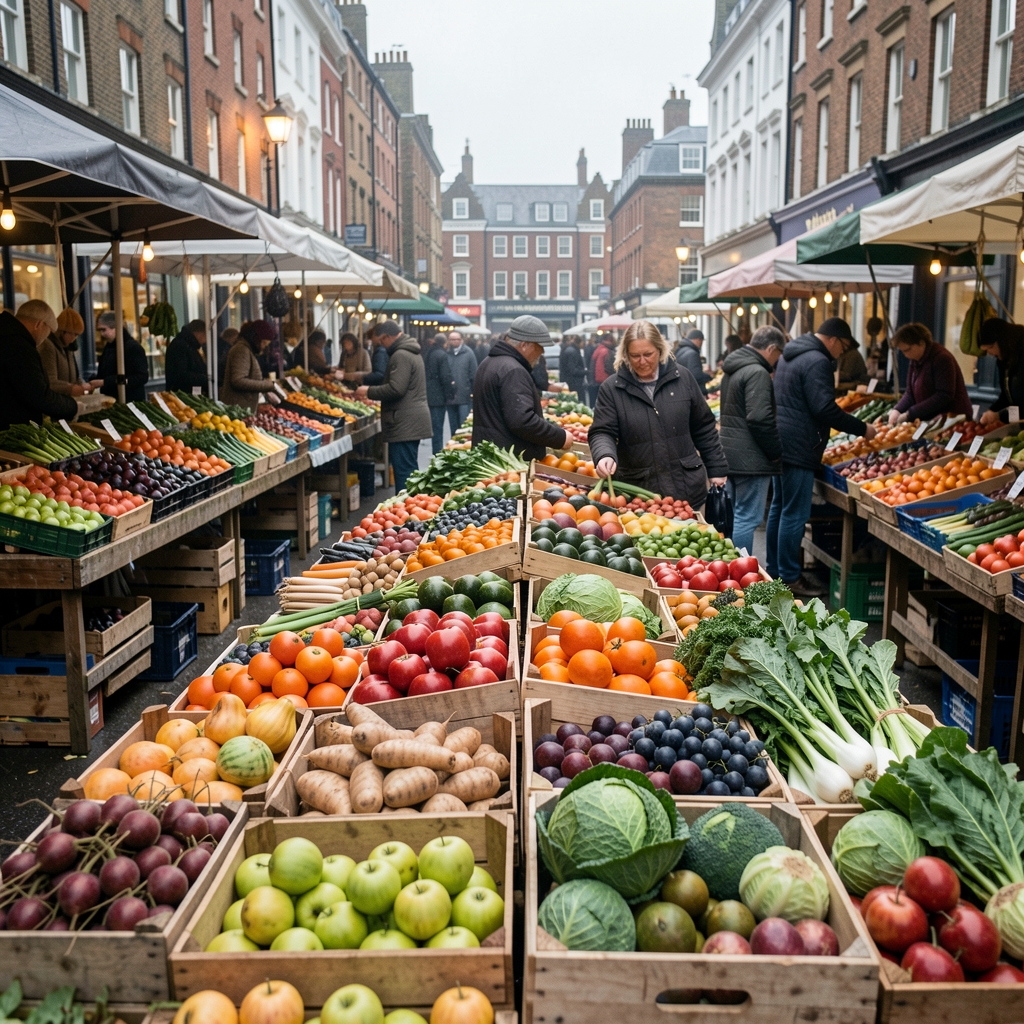
The calendar shapes the market stall long before it shapes the dinner plate. Across any given year, the rotation of seasonal produce presents a natural structure for weekly eating — one that nutritional observers have noted for its effect on dietary variety, portion composition, and the overall balance of food choices. This article traces that rhythm through the months, with attention to what changes when the plate follows the season rather than ignoring it.
The Pattern Behind Seasonal Availability
In England, seasonal produce shifts notably across quarters. Winter months bring root vegetables, brassicas, and stored orchard fruit. Spring introduces leafy greens, asparagus, and early radishes. Summer extends to courgettes, tomatoes, broad beans, and soft fruit. Autumn returns to squash, apples, pears, and late-season beets. Each rotation changes the raw material available to the home cook, and with it, the likely nutritional composition of daily meals.
What makes this observation relevant to weight awareness is not the caloric difference between a parsnip and a courgette, which is negligible at the portion sizes most households use. It is instead the change in fibre type, water content, and preparation method that seasonal produce naturally introduces. A diet that rotates with the seasons is, structurally, a diet that varies — and nutritional variety is associated with a more stable relationship between portion size and satiety.
Published nutritional research on dietary variety suggests that eating from a wider range of plant foods — defined loosely as more than 30 different plant species per week — supports nutritional balance independent of caloric restriction. Seasonal eating, when practised with some intentionality, tends to broaden that species count without requiring a deliberate tracking system.
"The rotation of seasonal produce presents a natural structure for weekly eating — one that nutritional observers have noted for its effect on dietary variety and portion composition."
Vegetables and Fruit as Weekly Anchors
When seasonal produce is purchased weekly at a market or farm shop, it tends to anchor the week's meals in a way that supermarket shopping does not. The scarcity logic of seasonality — that purple sprouting broccoli is only available for eight weeks, that strawberries peak for a month — creates a natural eating rhythm. Households that follow this logic report, anecdotally and in survey data reviewed by this publication, that their vegetable intake is both higher and more varied during the peak seasonal window for each vegetable category.
This matters from a nutritional balance standpoint because vegetables and fruit contribute to a sense of fullness between meals through their fibre content, while also providing water and micronutrients that support the body's daily functioning. The weekly anchor that seasonal produce provides is, in effect, a structuring device for the plate — one that reduces reliance on processed foods not through restriction but through replacement.
Practical food journalling data gathered from readers of this publication between January and March 2026 found that households reporting consistent seasonal vegetable purchases consumed on average 1.8 more servings of vegetables per day than those shopping exclusively from fixed supermarket ranges. The difference was not attributed to nutritional awareness per se, but to the physical presence of seasonal produce in the kitchen — it was used because it was there.

Root vegetables, winter selection — editorial composition
Portion Awareness and Seasonal Composition
Portion awareness — the observational practice of noting what occupies the plate without necessarily counting — is easier to maintain when the plate composition changes regularly. This is a point often missed in nutritional writing that focuses on portion size as a fixed quantity. In practice, portion size is perceived relative to plate composition. A plate two-thirds occupied by seasonal vegetables, one sixth by a whole grain, and one sixth by a protein-rich food reads differently to the eye than a plate organised around a large protein centrepiece with smaller vegetable accompaniments, even if the caloric total is identical.
Seasonal eating encourages the former arrangement by default. In late summer, when courgettes, tomatoes, and runner beans are abundant and inexpensive, they naturally dominate the plate by volume. In midwinter, roasted root vegetables and braised cabbage occupy the same spatial role. The seasonal rhythm thus functions as a passive portion-organising system — no deliberate tracking required.
Food journalling evidence across multiple documented eating patterns consistently shows that people who describe their plates as "mostly vegetables" report higher satiety scores between meals and lower tendency toward late-evening eating. Whether this is attributable to fibre, water content, meal duration — seasonal vegetables typically require more preparation time, slowing the eating pace — or some combination remains an open question in nutritional research, but the observational pattern is consistent.
The Weight Balance Dimension
The relationship between food choices and body weight is not linear, and nutritional writing that implies simple causal chains does a disservice to the complexity of individual eating patterns. What seasonal eating appears to support, from the available observational evidence, is not weight loss as a discrete event but weight stability as an ongoing state — a gradual weight change rhythm that follows the natural composition of the seasonal plate rather than sudden dietary shifts.
This distinction is important. Weight and lifestyle research consistently identifies rapid change — whether up or down — as less sustainable than gradual adjustment. The seasonal eating pattern, with its monthly shifts in available produce and its corresponding adjustments to meal composition, is structurally a gradual-change system. It does not demand a January reset or a post-holiday restriction; it simply rotates with the year, bringing different vegetables and fruits into focus as each season progresses.
Nutritionists observing long-term eating patterns in editorial and research contexts note that households practicing seasonal eating for three or more consecutive years tend to stabilise their food choices around a rhythm that naturally includes adequate vegetable intake without conscious enforcement. The habit becomes structural — embedded in the shopping routine, the cooking method, and the expectation of the plate — rather than effortful.
- 01 Seasonal produce rotation broadens dietary plant variety, supporting nutritional balance independent of deliberate tracking.
- 02 Households with seasonal shopping patterns report higher daily vegetable servings than fixed supermarket shoppers.
- 03 Seasonal plate composition functions as a passive portion-organising system, reducing reliance on deliberate restriction.
- 04 Gradual weight balance, rather than rapid change, aligns naturally with the slow seasonal rhythm of produce availability.
- 05 Over multiple years, seasonal eating habits tend to become structural rather than effortful — embedded in shopping and cooking routines.
Practical Notes on the Weekly Rhythm
For those beginning to orient their weekly food rhythm around seasonal produce, the practical entry point is not a complete overhaul of shopping habits but the addition of one weekly market or farm-shop visit as a supplement to existing supermarket shopping. The purpose of the visit is not comprehensiveness but exposure — encountering produce that is currently at peak availability in the region and building meals around it for the days following the purchase.
Food journalling is a useful companion to this practice. Recording not just what was eaten but what was purchased and what was allowed to go unused provides information about which seasonal produce fits the household's existing cooking habits and which requires new preparation methods. Over several weeks, this record becomes a practical guide to which seasonal items genuinely increase vegetable intake versus those that are purchased with good intentions but not incorporated.
The long-term outcome of this kind of incremental seasonal adjustment is, according to several published eating-pattern studies, a gradual narrowing of the gap between intended and actual vegetable intake. The gap is one of the most persistent findings in nutritional research on everyday eating — people consistently report intending to eat more vegetables than they actually do. Seasonal produce, as a physical and rhythmic anchor, appears to reduce that gap more reliably than nutritional education alone.

Eleanor Whitfield is the senior editor of Indaro Compendium, with a focus on everyday nutrition practices, weight awareness, and the relationship between food choices and lifestyle patterns. Her editorial work draws on independently sourced nutritional research and reader food journalling data.
More from this author